


Teacher and Let Toys Be Toys campaigner Megan Perryman shares how her school took on stereotypes through a whole-school gender equality week.
Exploring the concept of unconscious bias with a room full of seven year olds certainly gets you thinking. “Why do you think you assumed the picture of the man was the firefighter?” I asked them. A girl’s hand shot up. “Because boys are strong and brave and girls aren’t” she answered with a huge smile, confident she had given me the right answer.
Stereotypes in education – becoming a teacher
We established Let Toys Be Toys in 2012 because we were concerned about the effect of gender stereotyping on our children. As most of us were parents, we used the experiences we had with our own children to challenge stereotypes in retail, toy manufacturing and publishing.
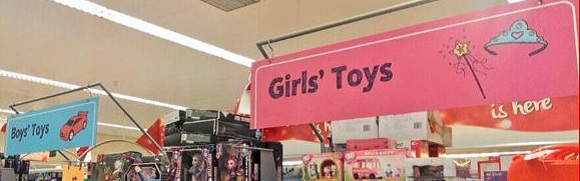
If my children encountered stereotypes at nursery or school it frustrated me and I wondered if education might be part of the problem.
Five years later I made the decision to change my career and retrain as a primary school teacher. I could now see those stereotypes from the other side, observing a far greater number of children and understanding much better the role we all have to play in either promoting or preventing how stereotypes affect children’s development.
I’ve seen boys dominate the football pitch, read girls’ stories about becoming a princess and overheard countless conversations about ‘boy toys’ and ‘girl colours’. But I’ve also watched boys and girls work and play collaboratively. I’ve met countless caring boys and boisterous girls. And I’ve heard children correct each other with “no, colours are for everyone”. It is clear to me that boys and girls are more alike than they are different.
John Hattie, Professor of Education agrees: “Overall, the differences between males and females should not be of major concern to educators. There is more variance within groups of boys and within groups of girls.” (Visible Learning: a synthesis of over 800 meta-analyses relating to achievement).
Despite that, I’ve had to challenge myself again and again. Why did I plan an art history lesson and completely forget to include some female artists? Why did the boy who misbehaved get a different tone of voice from me than the girl who did the same thing? Why do I persist in using male pronouns for animals or monsters?
Being a co-founder of Let Toys Be Toys, it seems, is not enough to completely rid yourself of unconscious bias.
Gender stereotypes: the latest fad in education?
Challenging stereotypes is something educators do every day, and is a statutory part of our job (via the Equality Act and PSHE guidance). Rather than being a modern fad, teachers have been challenging assumptions for decades, though the job isn’t yet done.
Barbara Burke worked in Hackney and Newham from 1968 – 2008. She recalls, “We tried hard to avoid sexism in the classroom and were particularly aware of it from the 1970s onwards. I remember a colleague observing my lesson and noticing that I answered questions from the boys more than the girls. It was great feedback as it forced me to think about how I treated everyone in the class.”
Gender Equality Week
I’m lucky enough to work at a school that understands the problems of stereotyping and we recently held a Gender Equality Week, focused on exploring and challenging gender stereotypes from nursery through to Year 6.
Across the week children examined their own biases and those in society. They looked again at the books, toys and clothes around them and discovered something new. Our aims were explicit with the children and parents, with a letter sent home beforehand explaining that this would be a great opportunity for children to explore issues surrounding gender stereotypes, consider ways they can challenge biases that exist, and celebrate who they are.
Early Years: thinking about jobs and toys
The very youngest in the school explored what it means to be a boy or girl through dressing up, sorting toys and learning about jobs in the adult world. Staff allowed children to look at these themes through independent play and group activities, gently challenging any stereotypes that arose.
Catherine Cardy, Assistant Headteacher and EYFS lead, said, “It’s been interesting to hear the preconceptions that some of the nursery children come to school with. I’ve heard children refer to ‘boy books’ or ‘boy cartoons’ and many still talk about policemen and firemen. All of these misconceptions are addressed of course.”
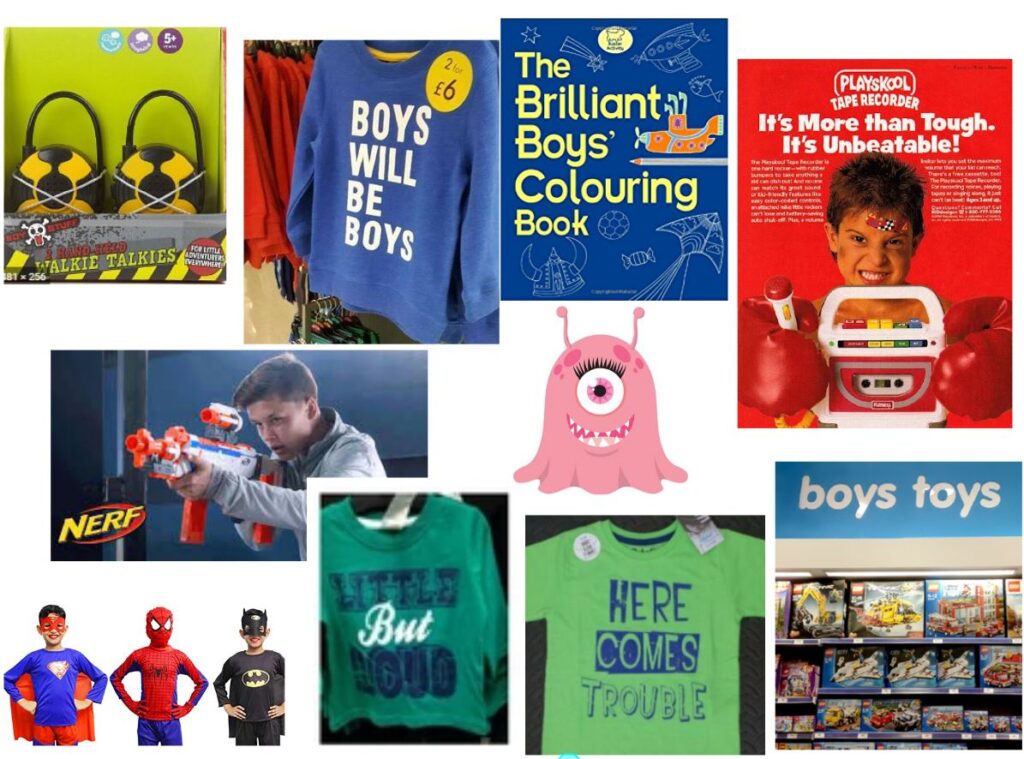
Year 6: what’s best and worst about being a girl or a boy?
At the other end of the school Year 6 (10-11) explored the gender pay gap and discussed the best and worst things about being a girl or a boy. The best things about being a girl were mostly around appearance: hair, eyelashes and make-up, although interestingly they also said that boys aren’t allowed to hurt girls, and that nowadays girls can do any job they want.
The boys also mentioned physical characteristics such as hair, adam’s apple, muscles and the ability to pee standing up! They said that benefits of being male were football and running, whereas physical activity wasn’t mentioned for the girls at all.
When discussing the drawbacks to being a boy or a girl, all children seemed aware of societal expectations. One girl said the worst thing was “when you wear boys’ clothes people say you can’t” and another said “people assume you like glitter”.
Boys said “people don’t expect you to wear pink or purple because they’re for girls” and “people might laugh at you for things you do”. One boy worried about “losing your job because then there’s no money for your family” and it’s interesting that he linked this responsibility to being male.
When asked if boys and girls are treated the same at school, they said “if girls want to play football, they’re judged” and “girls are teased about being tall”. And when asked if boys and girls are treated the same at home a few children mentioned that girls do more cleaning and cooking, and that they are expected to wear dresses at special occasions.
The Year 6s certainly have more of an understanding of gendered issues than the younger children, but that doesn’t stop stereotypes from impacting their lives.
Year 2: a gender audit of our bookshelf
In my Year 2 class we examined toys, books and advertising to find out more about stereotypes associated with boys and girls. We learnt about the history of pink and blue to try to reclaim those colours from the stereotypes.
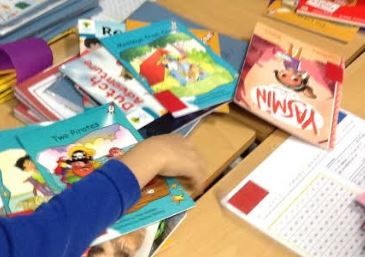
We audited the books in my classroom and the findings were interesting. We found 117 books with a male protagonist, 64 books with both male and female leads, and only 57 that were focused around a girl. We try very hard at my school to source books that are as diverse as our children, and I suspect that without that effort the statistics would be far worse.
Looking at jobs: firefighter or nurse?
With a previous year group I’d asked my Year 2 class to identify the firefighter or the nurse from two images of a man and a woman. Most assumed the man was the firefighter and the woman was the nurse, although it was the other way round. Aside from the girl who confidently informed me that boys are more brave and strong, they found it a real challenge to explain the reasons for their assumptions.
In Gender Equality Week I asked them to draw a teacher, doctor, scientist, police officer, firefighter and a nurse. I was careful to do this exercise at a different time of day and tied into a different subject so they weren’t overly aware of what I would be looking at. The findings are as follows (and don’t always add up to 30 due to absences and some children not finishing the task).
The teachers were more likely to be female (18 versus 6). The doctors slightly more likely to be male (14 versus 10). The scientists were also more likely to be male (15 versus 9). The police officers were mainly male (16 versus 8). The firefighters male (14 versus 9) and the nurses were relatively balanced (6 female, 5 male).

It was interesting to see that some girls drew every person on their sheet as female; I’m not sure if this is a good sign or not! The children were slightly more balanced than previous experiments of this kind; The Inspiring the Future – redraw the balance experiment found 61 out of 66 children drew a firefighter, surgeon and fighter pilot as male.
How do stereotypes shape children’s future dreams?
I asked the children about the career they would like to do themselves. The boys answered:
Footballer x 4, police officer x 3, scientist x 2, train driver x 2 and a fighter pilot.
The girls answered:
Fashion designer x 2, teacher x 2, dancer, model and singer but we also had a physicist, a police officer, three doctors and (somewhat disconcertingly) a kidnapper!
It seems that the girls were slightly more likely to think outside the stereotypes and this fits with findings from elsewhere. The Geena Davis Institute recently discovered, when undertaking research for Lego, that a troubling 71% of boys worry about being teased if they play with so-called ‘girl’ toys.
Indeed, it seemed to take some courage for a boy in my class to tell us “I sometimes play with girl toys.” (I did, of course, reassure him that if he’s playing with it then it must be a boys’ toy as well!) A girl also told us “I like playing PacMan even though it’s a boy game” which had myself and two Teaching Assistants enthusiastically reassuring her that PacMan is – and always has been – for everyone!
Beyond Gender Equality Week: dealing with everyday challenges
Challenging stereotypes is of course a continuous process, and not something that can be covered in a week. At Let Toys Be Toys we’ve published Ten ways to challenge gender stereotypes in the classroom based on suggestions from the National Education Union. This resource offers simple, everyday ways for teachers to raise and challenge stereotypes through the jobs children are given, the way the class is divided up, the use of diverse visible role models and choosing supportive resources.
Stereotypes matter
The boys and girls who share interests and work side by side as six-year-olds are likely to take on board the stereotypes as they grow older. In 2021 94% of students sitting an A-Level in performing / expressive arts were female. Computer Science entries were 85% male.
These differences can also be seen in the world of work. 90% of the world’s nurses are female and 85% of the UK’s engineers are men. Men are more likely to hold positions of power or earn the highest salaries, and conversely are more likely to commit suicide or end up in prison. Two women a week are killed by a current or former partner in England and Wales alone and the majority of sexual assaults and rapes are committed by men against women and children.
Nature or nurture (and does it matter)?
This poses the interesting question about how much is that difference due to nature and how much due to nurture. Gina Rippon, Professor of Neuroscience, believes that the stereotypes themselves could be leading to difference: “Stereotypes could be straitjacketing our flexible, plastic brains. So, yes, challenging them does matter.” (The Gendered Brain).
Ultimately, whether you believe girls and boys are fundamentally different or they are taught to be so, we certainly live in a highly gendered world, which gives children strong messages about what boys and girls are meant to be like. Supporting all children to develop in a rounded way can only be a good thing.
It would be nice to say that Gender Equality Week solved all our problems. Although it started an important conversation, the boys still dominate the football pitch and children still make comments that are stereotypical. What I’ve learnt from it is the difference that can be made by simply talking about the things that seem self-evident to us as adults – girls and boys can like the same things, colours are for everyone, men and women can do the same jobs…
Children need the opportunity to share their worries and to be explicitly reassured that there are many ways to be a boy, and many ways to be a girl. It’s going to take all of us – parents, educators and society as a whole – to keep talking, keep challenging and keep listening to what children really want.