

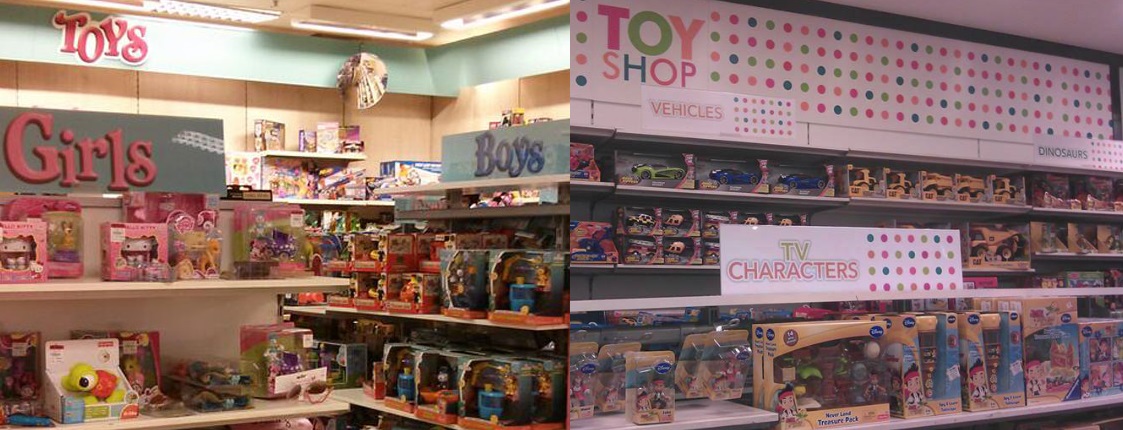
Tricia Lowther explains why campaigning against gendered toy marketing is important, in an open reply to Sam Leith of the Guardian.
Sam Leith wrote a dismissive comment piece in yesterday’s Guardian, about the aims of campaigners who oppose gendered toy marketing. He started by talking about his children, as those who oppose the campaign often do, the suggestion being that there’s no problem with restricting children to stereotypes in toy marketing, because his daughter likes pink and his son likes fire engines.
The Marks and Spencer announcement will make no difference to his children’s obsessions he says. This may well be true, but, along with the other changes taking place in stores, it may be a step toward lessening the restrictions that prevent many children from experiencing a wide range of play activities, so why object?
Leith says there’s a strong case for “not getting ventilated about” gendered toy marketing, because it’s; “a sideshow that distracts from the “main event”, which is a “mile-wide, mile-deep underground mycelium of which it is an emanation.” I presume by this that he means talking about toys distracts from more important issues connected with endemic sexism in society. Challenging the gendered marketing of toys is a tiny part of challenging attitudes towards gender, I would accept that, but it certainly ties in to and raises awareness around, much larger issues.
Our campaign focus is deliberately narrow, it seems to be the easiest way to gain ground by asking for progress one step at a time, but it’s raised the volume on the discussion around the ways in which children are socialised into gender roles. Examples of this include international news coverage, and involvement in a week long series of tv shows in which CBBC’s ‘Newsround’ looked at how gender stereotypes affect children in all sorts of ways. And toys are not trivial to a child.
As Maria Montessori said; “Play is the work of the child” and “toys are the tools”. Albert Einstein agreed that; “Play is the highest form of research.”
To dismiss this as a trivial issue is to dismiss the concerns of children as trivial. Play is important to a child, play shapes a child’s world, it’s how they learn about the roles and possibilities open to them in life. So when children are steered towards certain toys they are steered towards developing skills and interests that will continue throughout their lives.
“Children are actually pretty good at differentiating fantasy and reality: arguably, rather better than adults,” says Leith. In fact, young children lack the critical faculties to challenge gender stereotypes, they accept the rules that adults lay down for them. The period from birth to age seven is known as ‘The Imprint Period’, sociologist Morris Massey says that; “Up to the age of seven, we are like sponges, absorbing everything around us and accepting much of it as true”.
We need to show children stereotypes says Leith, so that they can consider them critically. Really? How about just trying to get rid of them in the first place? I wouldn’t argue with the fact that children need to learn how to be critical of media, but how does that square with the argument that adults should not challenge it?
Leith’s ‘professor of gender studies’ friend was, he says, relatively relaxed about the idea that her children would experiment with a whole series of roles and, yes, stereotypes. I’d agree, my daughter has a Disney Princess doll, she has fluffy kittens and a sparkly dress, she also has a telescope, building toys and dinosaurs, but that didn’t stop her from telling me recently that she didn’t want anyone to know she liked the film ‘Cars’, because it is ‘boyish’. And what about those children who don’t get that range, wouldn’t they benefit if the toy industry let up with the stereotypes?
Leith thinks toys don’t have a profound effect on the way children understand gender roles. I think children are bombarded with gender stereotypes from a young age, and toy marketing is a contributory factor. Saying it isn’t a big issue, is not an argument for saying it’s not worth challenging, and the huge resistance in some quarters, to the simple changes we’ve asked for, suggest that some really entrenched attitudes are being challenged.
Leith ends his comment with the insult – “Knocking the “Boys” and “Girls” signs off the toyshop shelves is a nice thing to do – but it’s something we do for ourselves more than for our children.” Our campaign is all about the wellbeing of children; we receive messages every day that show how children have been upset, confused or even bullied because of the attitudes we do our best to challenge. We believe it’s past time parents started demanding the same measure of equal opportunity and respect for the full potential of children, that we have come to expect for adults, and we won’t stand silently by and let the toy industry impose limiting stereotypes on our children.