


Our survey of online stores shows ’Girls’ and ’Boys’ navigation options are falling out of favour.
In November Let Toys Be Toys campaigners reviewed online stores to see how many of them encourage shoppers to use gender to help them choose toys and books for children.
Just over half the sites we looked at showcased toys without using gender signposting, and, compared with our 2012 survey, the proportion offering ‘Boys’ and ‘Girls’ options has declined by 46%. Household names including Tesco, Asda, Boots, M&S, Sainsbury’s, Hamley’s, Ocado and Selfridges have dropped gendered navigation or filters during this time.
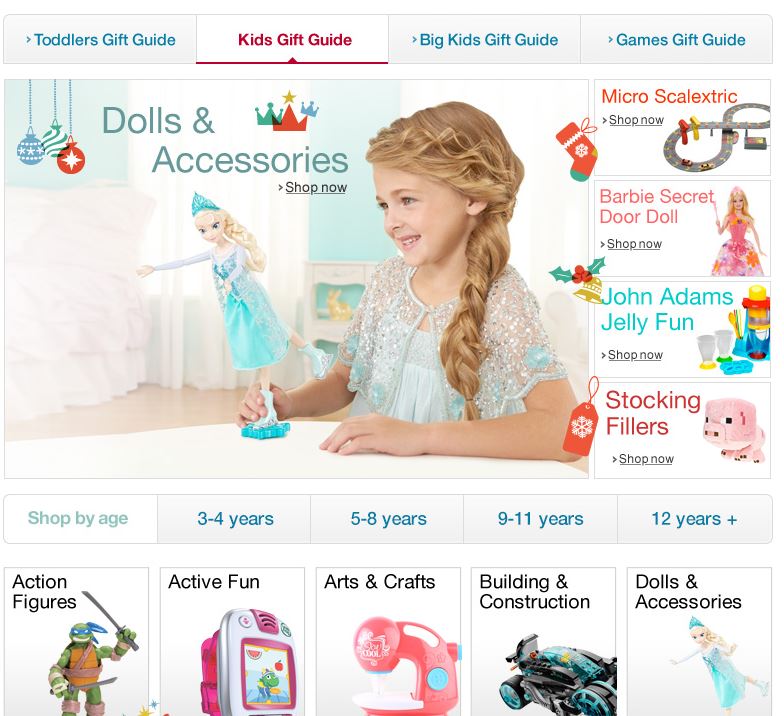
Amazon.co.uk’s gift guide page offers plenty of options to browse, but does not categorise toys by gender.
In total, 24 of the 50 sites reviewed did use gendered signposting such as ‘Boys/Girls’ filters, present pickers or gift guides, 12 of them as a primary or prominent way of navigating products.
Sites that did not use gender filters, including Amazon.co.uk, Argos.co.uk and Tesco.com, offered a wide choice of options for browsing and filtering products, including category/toy type, price range, suitable age range, customer ratings, brand, character and more.
Example: Tesco.com
The Tesco.com website now presents a large selection of toys without using gender as a navigational tool, instead allowing shoppers the chance to browse by ‘Category’, ‘Age range’, ‘Brand’, ‘Price bracket’ and ‘Top toys this Christmas’.
Products labelled as ‘Boys’ and ‘Girls’ on the Tesco website in 2013.
When we contacted Tesco in 2013 about their categorisation of science toys as ‘Boys’ and toy kitchens as ‘Girls’ they initially responded that customers needed these options.
But shortly afterwards they took the decision to remove the gender options from their site. Read some of the tweets and news reports from the time.
The site now offers ‘Category’ (e.g. Action figures, Animals and playsets…) as the primary navigation in the toys section, with options to browse by ‘Age’, ‘Price’, ‘Brand’ and ‘Special offers’.
What’s the problem with organising toys online by gender?
At Let Toys Be Toys we believe that there is no such thing as a ‘girls’ toy’ or a ‘boys’ toy’. A child should feel free to pick up and play with any age-appropriate toy they like. Marketing toys by gender limits children’s choices, limits their chances to learn and develop and feeds bullying. Read more about why it matters.
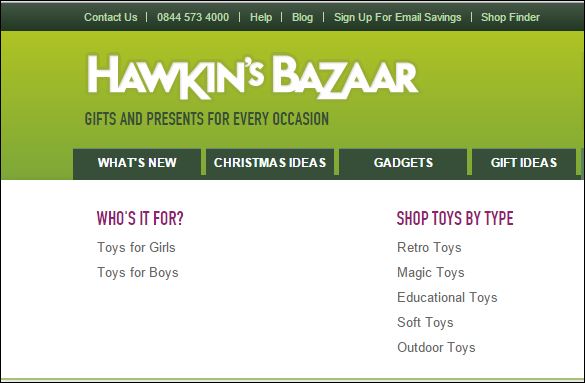
On the Hawkin’s Bazaar site gender is the first navigational option in the toys section.
Companies defend the decision to organise toys into ‘Boys’ and ‘Girls’ categories, or to filter options by gender, by saying that they are helping customers. The same arguments were made for signage in toy shops, but following a 60% drop in ‘boys’ and ‘girls’ signage last year, shoppers seem still to be able to find a dolly under ‘dolls’ instead of ‘girls’. We’re just asking retailers to say what it is, not who it’s for.
Offering ‘Boys’ and ‘Girls’ categories suggests to shoppers that gender is a good way to decide what will interest a child. It simply isn’t – selecting toys by gender means that children will only be offered a limited range, and may miss out on the chance to find and enjoy things that really interest them.
When retailers talk about the uncles, aunts and grandparents who would be lost without something telling them what to buy for ‘a girl age 6’, they are underestimating the majority of relatives who know more about the children they shop for than their age and sex, or who take the time to ask parents or carers about children’s interests. They also do a disservice to children, whose interests range more widely than the narrow pink and blue boxes of gender stereotypes, and who don’t deserve to be told that their interests are ‘wrong’.
“I often buy presents for my grandchildren online, and that’s easiest when toys are arranged by type. For example, two of my grandchildren (a girl and a boy) currently enjoy playing with small plastic people – whether that’s pirates, fairies, knights etc. If a website is divided into ‘boys’ and ‘girls’ I have to check both sections, so I tend not to bother and find a more helpful website.” Barbara Burke, present-buyer to four young grandchildren.
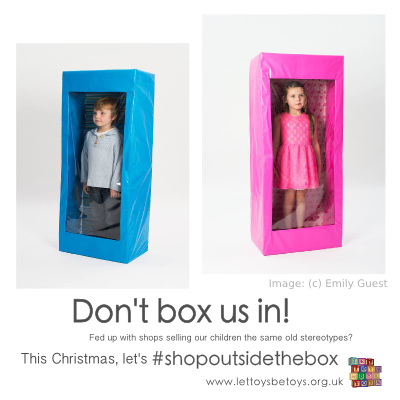
Shop outside the box
This Christmas we’re encouraging shoppers to bust the pink and blue stereotypes and ‘shop outside the box’.
[zilla_button url=”https://www.thunderclap.it/projects/19683-shop-outside-the-box” style=”purple” size=”medium” type=”square” target=”_blank”]Help spread the word[/zilla_button]
Download full survey report: Boys’ Toys, Girl’s Toys or Toys for Children? How are retailers presenting toys online in 2014?